Working Texans Face an Alarming Retirement Savings Shortfall
(Press Release) A majority of Texans are not saving adequately for retirement. One key reason is that many do not have the opportunity to save at work, which is the best and most common way individuals build retirement savings.
Texans Are Not Adequately Saving for Retirement
• It is estimated that the average Texas private sector worker has $32,028 in his or her retirement account(s), far
below the 10 years of annual salary that many financial advisors recommend.i
• One in three Texans over 65 rely on Social Security as their only source of income. The average monthly Social Security benefit in Texas ($1,202) would replace only 27 percent of median household income in Texas.
• Disparities in access to a retirement plan at work are greatest for workers that are:
o employed by small businesses,
o under the age of 45,
o less educated,
o work in a low-wage job, and are
o Hispanic, Black or Asian.
• It is estimated that the average Texas private sector worker has $32,028 in his or her retirement account(s), far
below the 10 years of annual salary that many financial advisors recommend.i
• One in three Texans over 65 rely on Social Security as their only source of income. The average monthly Social Security benefit in Texas ($1,202) would replace only 27 percent of median household income in Texas.
• Disparities in access to a retirement plan at work are greatest for workers that are:
o employed by small businesses,
o under the age of 45,
o less educated,
o work in a low-wage job, and are
o Hispanic, Black or Asian.
Challenges to Increasing Retirement Savings Rates
• Beyond lacking access to a retirement plan at work, other
reasons Texans report for not saving include eligibility barriers such as full-time status, and being unable to afford contributions to a plan.
• Reasons cited by employers for not offering a retirement plan at work include business-related concerns such as unstable business income, cost, and employee issues such as high employee turnover.
• Beyond lacking access to a retirement plan at work, other
reasons Texans report for not saving include eligibility barriers such as full-time status, and being unable to afford contributions to a plan.
• Reasons cited by employers for not offering a retirement plan at work include business-related concerns such as unstable business income, cost, and employee issues such as high employee turnover.
Benefits to Increasing Retirement Savings Rates
• When Texans are provided an opportunity to save for retirement, they take advantage of it. Specifically, 84 percent of full-time, full-year workers that have access to a plan participate.
• Workers with increased retirement savings benefit from reduced worker stress, increased productivity, and a more secure financial future.
• Retirees with retirement savings are able to spend more money in their communities, and are more likely to be self-sufficient.
• Increased retirement savings rates also produce economic benefits to the state and save the state money. Using the conservative assumption that a state-administered retirement program would result in fewer workers on Medicaid and lead to a one percent reduction in Medicaid spending for workers over 65, one analysis estimates that such a program would save the state $55 million over a 5-year period.
• When Texans are provided an opportunity to save for retirement, they take advantage of it. Specifically, 84 percent of full-time, full-year workers that have access to a plan participate.
• Workers with increased retirement savings benefit from reduced worker stress, increased productivity, and a more secure financial future.
• Retirees with retirement savings are able to spend more money in their communities, and are more likely to be self-sufficient.
• Increased retirement savings rates also produce economic benefits to the state and save the state money. Using the conservative assumption that a state-administered retirement program would result in fewer workers on Medicaid and lead to a one percent reduction in Medicaid spending for workers over 65, one analysis estimates that such a program would save the state $55 million over a 5-year period.
Policy Solutions to Expand Retirement Savings in Texas
States have made significant progress to expand access to workplace retirement plans in the private sector, typically through the adoption of innovative public-private partnerships. Since 2012, nine states have passed new policies that are now being implemented.
States have made significant progress to expand access to workplace retirement plans in the private sector, typically through the adoption of innovative public-private partnerships. Since 2012, nine states have passed new policies that are now being implemented.
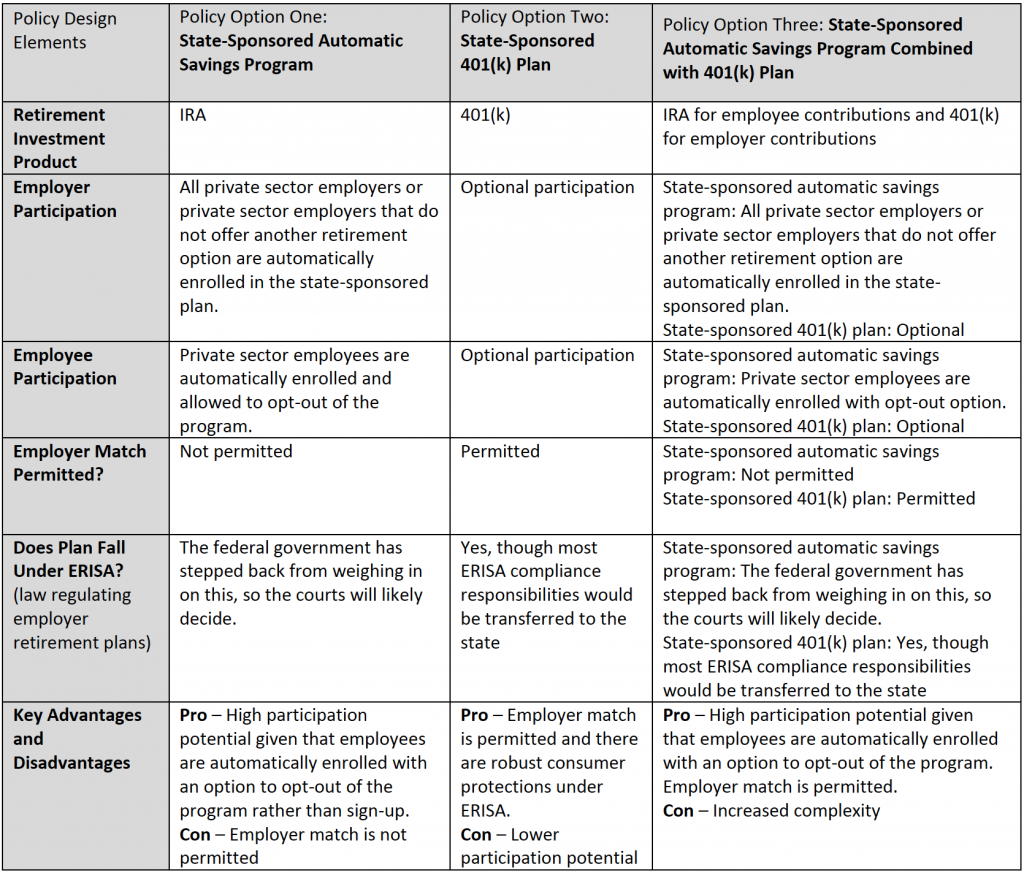
Texas has a similar opportunity to explore three policy approaches to expand access to retirement savings:
• State-Sponsored Automatic Savings Program – Through this program, private sector employees are automatically enrolled in an IRA plan overseen by the state and can opt-out of participating.
• State-Sponsored 401(k) Plan – Under this model, states can offer a (401)k plan called an open Multiple Employer Plan (MEP) to an unlimited number of employers and workers.
• Automatic Savings Program combined with a State-Sponsored 401(k) Plan – This model combines an Automatic Savings Program for employee contributions with a State-Sponsored 401(k) Plan for employer contributions.
• State-Sponsored Automatic Savings Program – Through this program, private sector employees are automatically enrolled in an IRA plan overseen by the state and can opt-out of participating.
• State-Sponsored 401(k) Plan – Under this model, states can offer a (401)k plan called an open Multiple Employer Plan (MEP) to an unlimited number of employers and workers.
• Automatic Savings Program combined with a State-Sponsored 401(k) Plan – This model combines an Automatic Savings Program for employee contributions with a State-Sponsored 401(k) Plan for employer contributions.
This chart summarizes the key features of these approaches. The automatic savings program and the automatic savings program combined with the 401(k) plan are expected to have the greatest impact on retirement plan access rates. In 2017, the 85th Texas Legislature considered HB 3601, which combined an Automatic Savings Program for employee contributions with a State-Sponsored 401(k) Plan for employer contributions, which would provide the most robust program.
Read the full paper, Working Texans Face an Alarming Retirement Savings Shortfall