96 Maverick County Students Participate in Texas Voucher Program
By Jose G. Landa, Copyright 2026 Eagle Pass Business Journal Inc.
Ninety-six students living within Eagle Pass Independent School District boundaries are participating in Texas’ new school voucher program, according to a state report, placing the statewide education initiative into the local discussion over enrollment and public school funding.
The figure appears in the Texas Comptroller’s August 1 demographic report for the Texas Education Freedom Accounts program. It represents students with funded accounts as of July 29 whose parents identified Eagle Pass ISD as their district of residence.
While the number documents local participation, it does not establish that 96 students withdrew from EPISD. The report identifies participants by where they live rather than confirming whether they previously attended public school, private school or received instruction at home.
That distinction matters when determining how much the program could affect the district’s finances.
A voucher awarded to a child already attending private school does not represent the same immediate enrollment loss as an EPISD student leaving a district classroom.
Texas lawmakers created the program through Senate Bill 2 in 2025 and provided an initial $1 billion appropriation. For the 2026–27 school year, participating private school students receive $10,474 annually.
Qualifying students may receive up to $30,000, while homeschooled students and students in other eligible settings receive $2,000.
The program is now operating statewide. An October 1 state update reports 110,578 participating students, although the earlier report listing 96 Eagle Pass participants should not be treated as a current October count.
For EPISD, the financial question centers on how many students leave district schools and the attendance-based funding those students would otherwise generate.
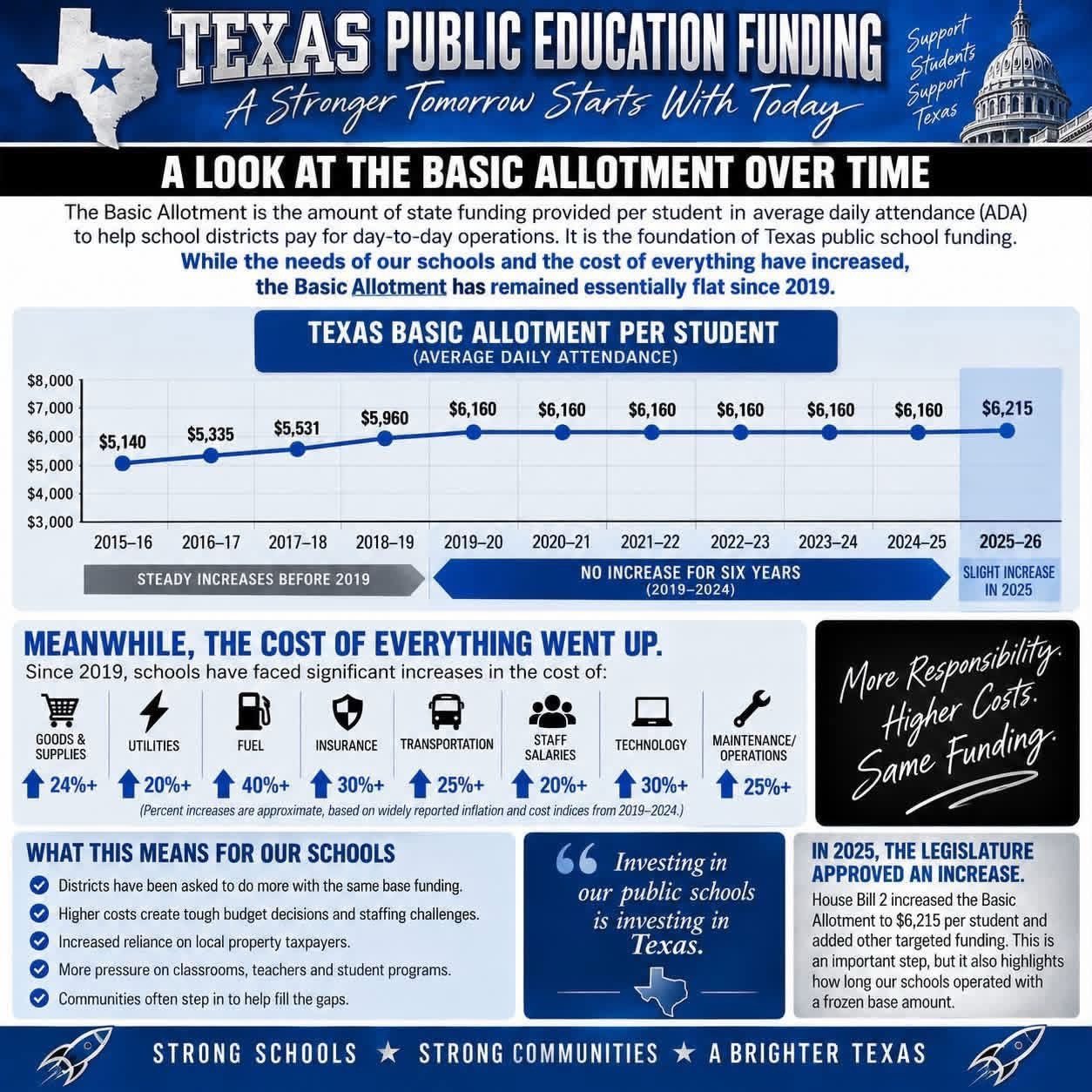
The Texas Education Agency sets the basic allotment at $6,215 per student in average daily attendance for the current biennium. Other funding components account for student characteristics and educational services.
As an illustration, a full-year reduction of 96 students in average daily attendance would represent $596,640 in the basic-allotment component alone.
That calculation is not a confirmed EPISD loss.
Ninety-six voucher participants do not necessarily represent 96 district withdrawals, and 96 withdrawals would not necessarily produce a reduction of 96 in average daily attendance.
The voucher amount also cannot be treated as a dollar-for-dollar deduction from EPISD’s budget. The state calculates voucher awards and public school funding through different formulas.
An enrollment decline could nevertheless create budget pressure.
Students leaving several campuses may reduce revenue without immediately eliminating the need for teachers, transportation, building maintenance and other operating expenses.
Determining the actual local impact requires EPISD’s withdrawal records, updated attendance figures and revised funding projections. Until those figures are available, the state report establishes local participation in the voucher program but leaves the district’s financial exposure unresolved.